
Not Another Outline!
By Ruth O’Neil

I groaned as my high school English teacher told the class that our senior research papers needed to include an outline. I loved writing; I hated outlines. Since I ended up writing never looked anything like the outline I created at the beginning of the assignment, I often wrote the paper first and then created the framework page she required.
When I was in high school, I didn’t understand my aversion to outlines. Now, as an adult, I understand completely. My brain doesn’t work in a straight line. My husband tells me that when I talk about what happened in my day, I go out and around three miles before coming to the point. How am I supposed to outline that? He doesn’t need details. I want to share every single one. In life, I always think of things I should have said or done after the fact. My writing ends up being the same. I needed some kind of process that would allow me to go back and add without having to rearrange everything else.
As an adult, someone told me about semantic webbing. On paper, it looks like a chaotic mess – a whole bunch of bubbles with a few words in them- but the truth of the matter is it is organized chaos. I can brainstorm a story and not have to work in a logical order from beginning to end. From there, I can easily create an outline that is legible to an editor. I use it in my classrooms to give students with non-linear brains an option for theirs. Some of them really enjoy using them. One of their assignments is to write a descriptive essay about a person. A semantic web is the perfect way to connect the different thoughts that randomly come to their minds as they brainstorm.
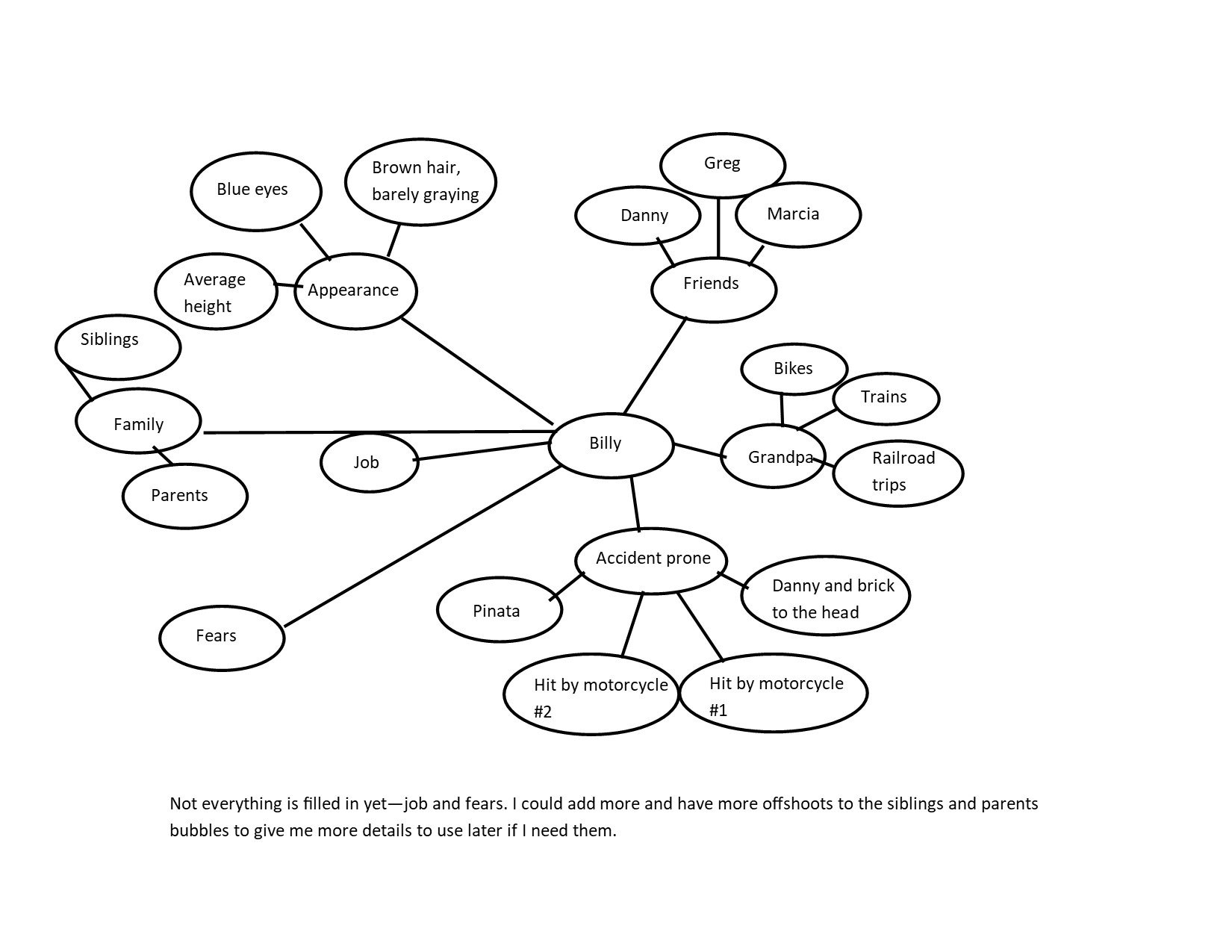
The beauty of semantic webbing is that you can use it for all facets of your story. Create a web for your plot lines, your characters, and your setting. Let’s create one for a character. Let’s call him Billy. I will put one bubble in the middle of a page and write the character’s name in it. The central bubble will have multiple bubble offshoots with other information. Other individual bubbles might include his appearance, friends, accidents, Grandpa, personality traits, fears, etc. The sky is the limit. You can create as many bubbles as you need to fully develop a character or plot line.
To each individual bubble, I will offshoot more with more information. For example, under friends, I would put a new one for each friend’s name. If there is something I want to include in my story about that friend specifically, I’ll start more offshoots from their name. Keep creating and filling in until your page is full. Start a new page if necessary. I like this method because I can go back and add something I may have forgotten or a new idea I may have thought up.
Now, how do you take all this organized chaos and create an outline? Your first bubble in the middle of the page is your main topic. The secondary bubbles are your different paragraph topics. The tertiary bubbles are the paragraph points. If I were going to write a descriptive paragraph about this person, I would have all the information I wanted to write about.
As I’m writing my novels, I lightly cross out information I’ve used about a character or a plot point on my web so I don’t use it twice. I may not use all the information I’ve added, but it’s there if I get stuck on my book and need more background about any of my characters or need to give them more depth. If I’m doing a plot point web, I can number them when I’m finished, so I know what order they need to appear in my book.
So, if you’re like me and your brain doesn’t think in straight lines, give semantic webbing a try. Be careful, though, you may find it a type of outlining that is fun!
Ruth O’Neil is a freelance writer who has published hundreds of articles in dozens of magazines as well as four novels and several devotionals. She homeschooled her children for 20 years and is now teaching English and writing classes at a homeschool co-op. In her spare time, she enjoys sewing quilts, reading all the books she can get her hands on, canning a variety of foods, and especially spending time with her family. Ruth and her husband have been married for more than 30 years. They have three married children, one grandson, and another grandbaby on the way.