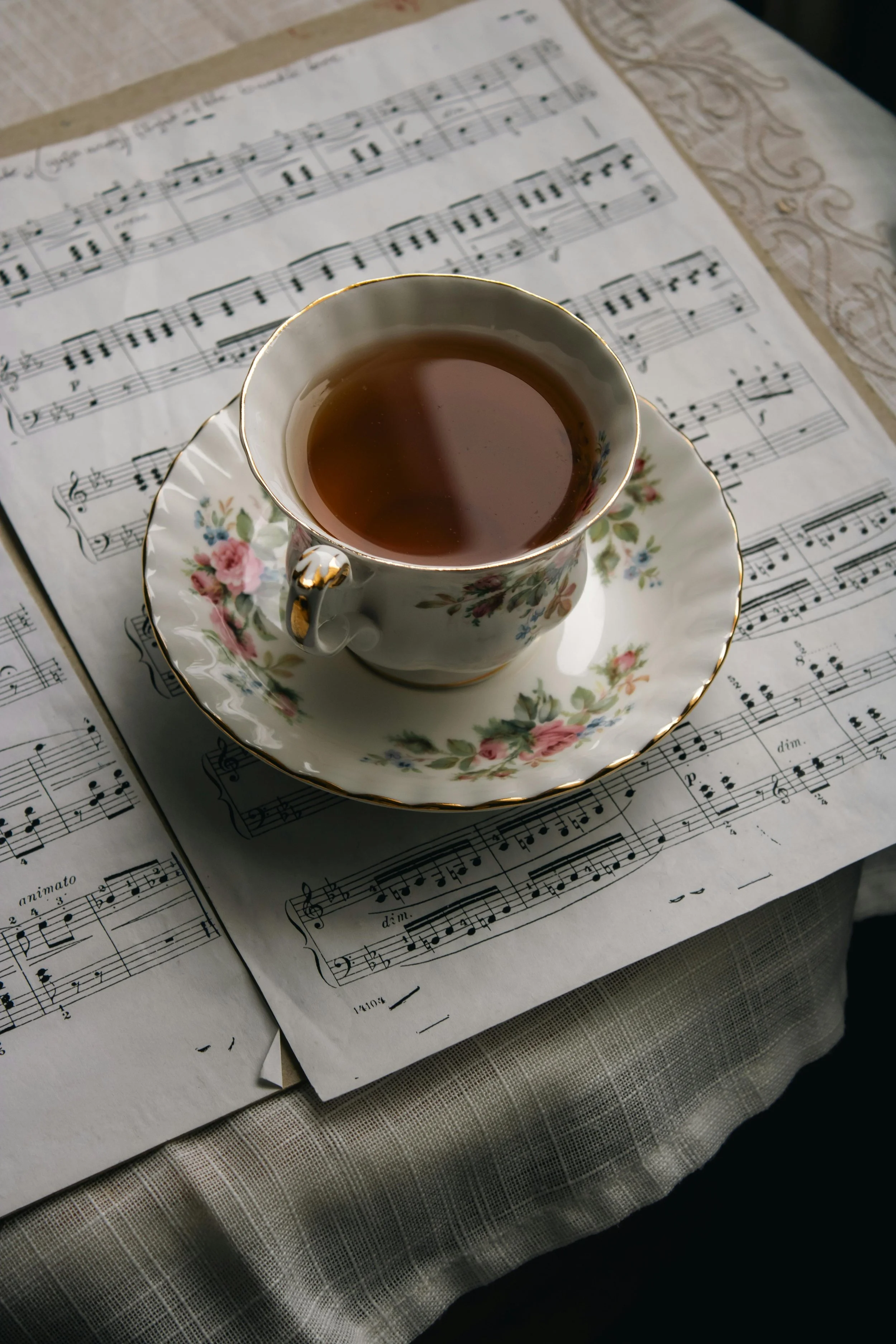
The relentless click-click-click of a metronome may be helpful for practicing finger exercises, but it’s deathly dull for an audience. Classical composers use Italian terms to signal changes in the desired pace of their music, such as lento (slow), allegro (lively), and presto (very fast). My favorite of these is rubato, literally “robbed” time, meaning the performer is free to “rob” a moment from one note and give it to the next.
Read MoreWe often speak of a writer’s voice, that distinct and resonant quality that separates one narrative from another on a crowded shelf. We talk of plot, of structure, of the muscularity of good prose. These are the tools of our trade, the timber and nails of the houses we build for our stories.
Read MoreToday, in 2026, when someone hears my accent and asks where I’m from, I hesitate. I lower my eyes, give a small smile, and say, “I was born and raised in St. Petersburg, Russia.” I hear the words and feel a pinch of embarrassment. I don’t always want to explain the Russia I knew—my Russia—because it feels so different from the Russia people picture today.
But things were very different in 1993. That was the year I moved, by a rather unlikely twist of fate, from St. Petersburg to a small college town with a surprising name: Moscow… Moscow, Idaho.
Read MoreWhat makes your writing unique? When readers come across your books, what do they see that makes them know it’s yours?
Establishing your position within the writing community can feel impossible, especially if you are just beginning your career. Each writer you come across pulls you in different directions, which can make it challenging to find your creative identity. The tendency to adopt the stylistic elements of a recently read work is a natural part of writing, one that contributes to your emerging voice.
Read MoreAs a judge for the popular storytelling platform NYC Midnight, I read a lot of flash fiction and microfiction submissions. For the unfamiliar, flash fiction is loosely defined as a short story of up to 1,000 words. Microfiction is a subset of flash fiction, with stories weighing in at 100 words or less.
Read MoreWhen I first began freelancing, it could get lonely. It was not like other jobs where you have coworkers with whom to bounce ideas off or solve problems, but writers need watering holes, too. Sometimes there is no one else that understands what you’re going through better than those who have been through it as well
Read MoreI groaned as my high school English teacher told the class that our senior research papers needed to include an outline. I loved writing; I hated outlines. Since I ended up writing never looked anything like the outline I created at the beginning of the assignment, I often wrote the paper first and then created the framework page she required.
Read MoreDriving down I-75 in Atlanta, a billboard blared: “Your Wife Is Hot! And she’s getting hotter!” In smaller print, the sign advertised an air conditioning company. I found the innuendo worth pondering. The writerly side of me mulled over creating a flash fiction on the double-entendre of “hotness.” I’d begin by saying Leroy’s wife was leaving him because after all she was much HOTTER than poor Leroy. When you read on, you’d find, the Mrs. was leaving her conjugal nest, not for another fella, but for her mom’s house where the AC worked. This is how a nugget of an idea mushrooms into a vignette! Surprise twists make stories interesting.
Read MoreIn 2021, I set out to write a book that had slowly been forming in my head for years. I work in creating affordable housing, and I’d always wanted a book I could leave behind with community groups, policymakers, and the like. Developing affordable housing is complicated and full of obscure jargon, but it’s all learnable. I wanted to write a book that would demystify what affordable housing is, how it works, what we’ve tried, and what is necessary to fix this housing crisis.
Read MoreWhen I first buckled down to seriously pursue my writing journey in my mid-20s, I had no intention of writing short stories. I wanted to pen the next great fantasy series, something akin to George R.R. Martin's A Song of Ice and Fire or Joe Abercrombie's The First Law Trilogy. What I discovered is that such series are tremendously difficult to create, especially as a newbie. Nevertheless, I persevered, and my writing improved, albeit at a slow rate.
Read MoreOft-quoted Virginia Woolf famously expressed her opinion that “a woman must have money and a room of her own if she is to write fiction.” Most writers remember the section of her quotation regarding the needed room—a place for creation, a sanctuary for expression, an atelier for sundry artistic pursuits. I agree. (I also concur with the part about having an income.)
Read MoreI write memoirs and sometimes my recollections are a bit hazy. I find that props help provide clarity. The publishing industry is rife with books and online writing classes that offer prompts to prime the creative juices. While writing prompts are useful exercises that may lead to deeper reflection, I love writing props to stimulate memories and jump-start the narrative.
Read MoreI participated in a reading at a bookstore to promote a writing group’s latest anthology of fiction. My niche remains the inspirational and humorous non-fiction narrative although I’ve penned novels.
Read MoreHave you ever done a ton of research for an article? Have you ever wished you could do more with that research? Research is time-consuming, and if you’re like me, you find other interesting topics to check out that lead down those dreaded rabbit holes. If you’re wise, you will use that research to the fullest and turn out more than one article, story, or listicle to get the most money for your work. Don’t be afraid to recycle and repurpose to fit the needs of multiple publications.
Read MoreOur purpose in writing nonfiction with a historical element is to inform and to entertain our target audience. That delicate balance is the challenge of creative nonfiction. How do we ensure that when we share colorful stories from the past we still apply the highest standards of accuracy available to us? This was the balance I aimed for after I had researched and photographed forty locations for my book ‘Paranormal Gloucestershire.’
Read MoreAs I wrapped up my first manuscript back in 2011, I didn’t really know what I wanted to do afterward, besides start shopping it for publication. From a young age, I’ve always wanted to finish what I start before I move onto anything else. People have even poked fun at my strategic way of eating each part of a meal one-by-one, with a swig of my drink in between. When it came to my writing pursuits, however, I realized that kind of approach could hamper my progress. As much as I wished I’d find a publisher right away, I knew that wasn’t likely, so I could spend years twiddling my thumbs until it happened. And what if I never received an acceptance letter? Would I give up on my dream just because my first attempt never took off?
Read MoreSecondary characters are the ones that crop up repeatedly in a narrative and actually influence the course of the story. Unlike with tertiary characters, who only appear in one or two scenes for a very specific purpose, you should know almost as much about your secondary characters as your main character — even if you don’t share it all with your readers. (That said, if your secondary character gains traction, you might get the chance to tell their full story in a spin-off.)
Read MoreAbout six months ago, I began a new daily writing practice. It’s deliriously simple, and it has fundamentally changed the way I think about writing as an act. It has also transformed my actual writing.
The practice is this: each day, I brainstorm one new fiction or creative nonfiction concept.
Like I said, it’s deliriously simple. Its simplicity is, I believe, key to its success. Its results have been profound.
Read MoreI never aspired to write books. Real writers wrote books. I was a screenwriter. I wrote scenes and dialogue. I didn’t want to wrestle with paragraphs and chapters. Leave that for the New York literati, I thought.
Read MoreSerendipity led me to serve as a judge for a state-wide writing contest. A friend had spoken of volunteering to do that kind of work, and we talked about giving back to the writing community. A month later, in a different city, I heard about a contest looking for volunteer judges. I applied and was accepted; I hoped I was ready.
Read More